
Arlington Heights, IL — On March 24, 2025, the Village of Arlington Heights received FOIA Request 25‑546, submitted by Northwest Central Pulse LLC in my role as a community reporter for AH Town Square. The request sought records to verify whether a local business owner, then actively campaigning for Village trustee, had obtained proper demolition permits. This inquiry followed the Village’s own admission that its online portal might not reflect a complete record of permits issued.
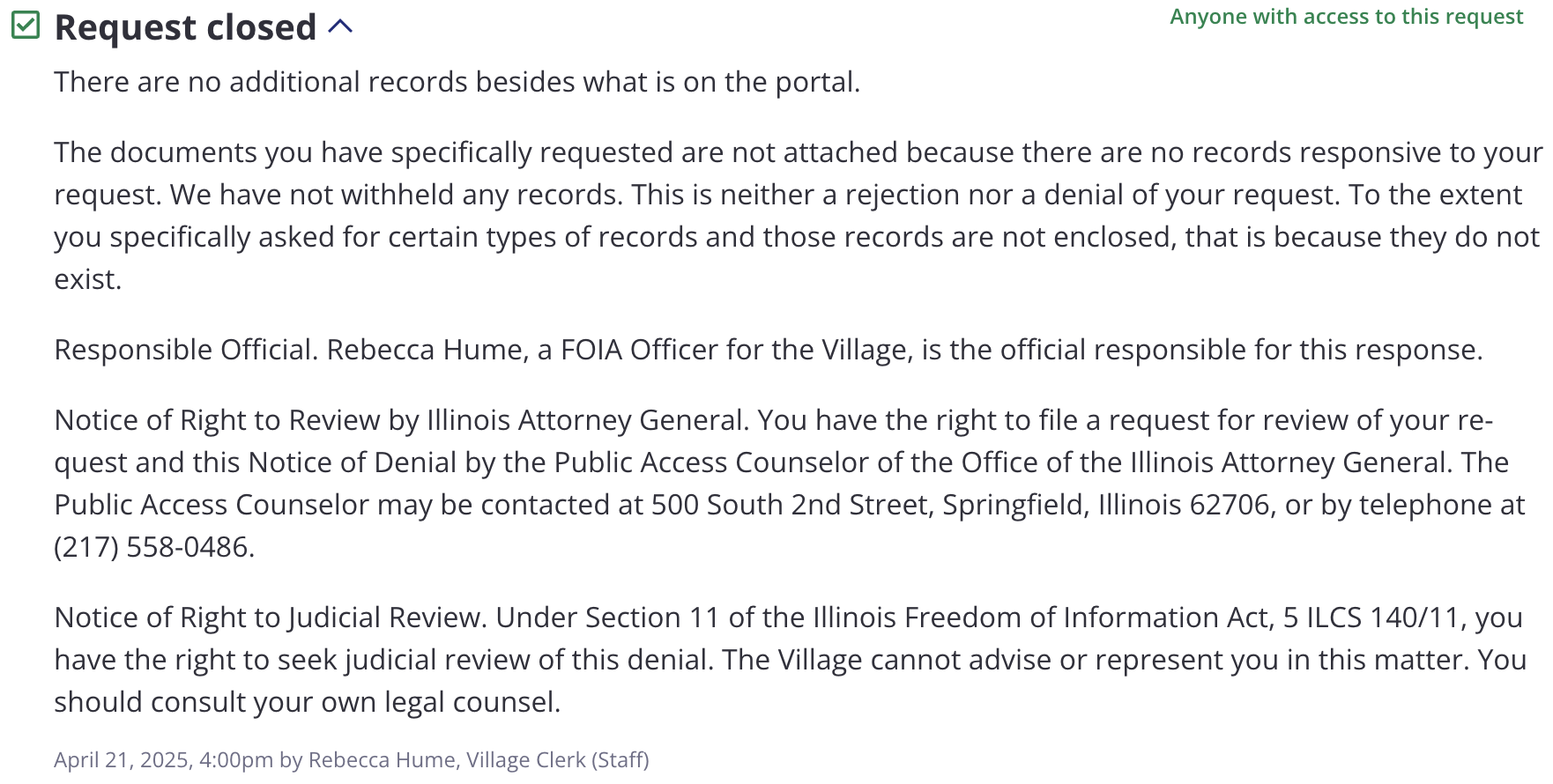
When the Village finally responded, 20 days later, well outside the legal deadline, the reply confirmed that no additional documents existed. In the official response, FOIA Officer Rebecca Hume stated:

“There are no additional records besides what is on the portal.
The documents you have specifically requested are not attached because there are no records responsive to your request. We have not withheld any records. This is neither a rejection nor a denial of your request. To the extent you specifically asked for certain types of records and those records are not enclosed, that is because they do not exist.”
While the records may not have existed, the delay itself speaks volumes. Under Illinois FOIA law, public bodies must respond within five business days. According to the Village’s own FOIA log (January 1 to April 7, 2025), the average response time is 3.2 days, with 81% of requests fulfilled within that five-day window. Many are completed in just one day.
Request 25-634
Log of public records requests from Jan 1–Apr 7, used to analyze response times.
Request 25‑546: Filed March 24, 2025; records received April 21, 2025
Typical Village Response Time: 3.2 days; 81% completed within 5 days
So why did this request take four times as long?
The delay resulted from labeling the request as coming from a “recurrent requester”, a category intended for individuals who submit high volumes of requests and are subject to extended response deadlines. But this request came from a registered media outlet, not an individual, and should have been processed under standard timelines for press inquiries.
The delay had consequences. Critical reporting on a candidate’s code compliance had to be postponed, depriving the public of timely information during a local election. For a process designed to ensure government transparency, this feels like a misuse of bureaucracy, intentional or not.
I’ve filed dozens of FOIA requests over the years, across multiple states and now regularly through AH Town Square, owned by Northwest Central Pulse LLC. Earlier this year, I filed a similar request under a different business entity, and it was fulfilled in five business days, proof that the rules are applied inconsistently.
This incident is more than just a clerical hiccup. It reveals a vulnerability in the system, one that can be exploited, even unintentionally, to delay uncomfortable scrutiny. And anything that interferes with transparency, especially during an election, deserves to be challenged.
We’ll be taking a deeper dive into every FOIA request received by the Village—analyzing who’s submitting them, how they’re handled, and whether the process is being applied fairly.
If you’ve experienced suspicious delays or unexplained denials with FOIA requests in Arlington Heights, we want to hear from you.